Mystic, Connecticut, 2010. I came across a little Candu E-Z named TooT TooT at the Wooden Boat Show. My wife Taylor took one look and said, “You can build that next.” I tracked down her builder, Mike, bought the plans, and in September 2022 I finally started cutting plywood.
The Build · 2022 – 2025
Plank by plank,
AWOOGA took shape.
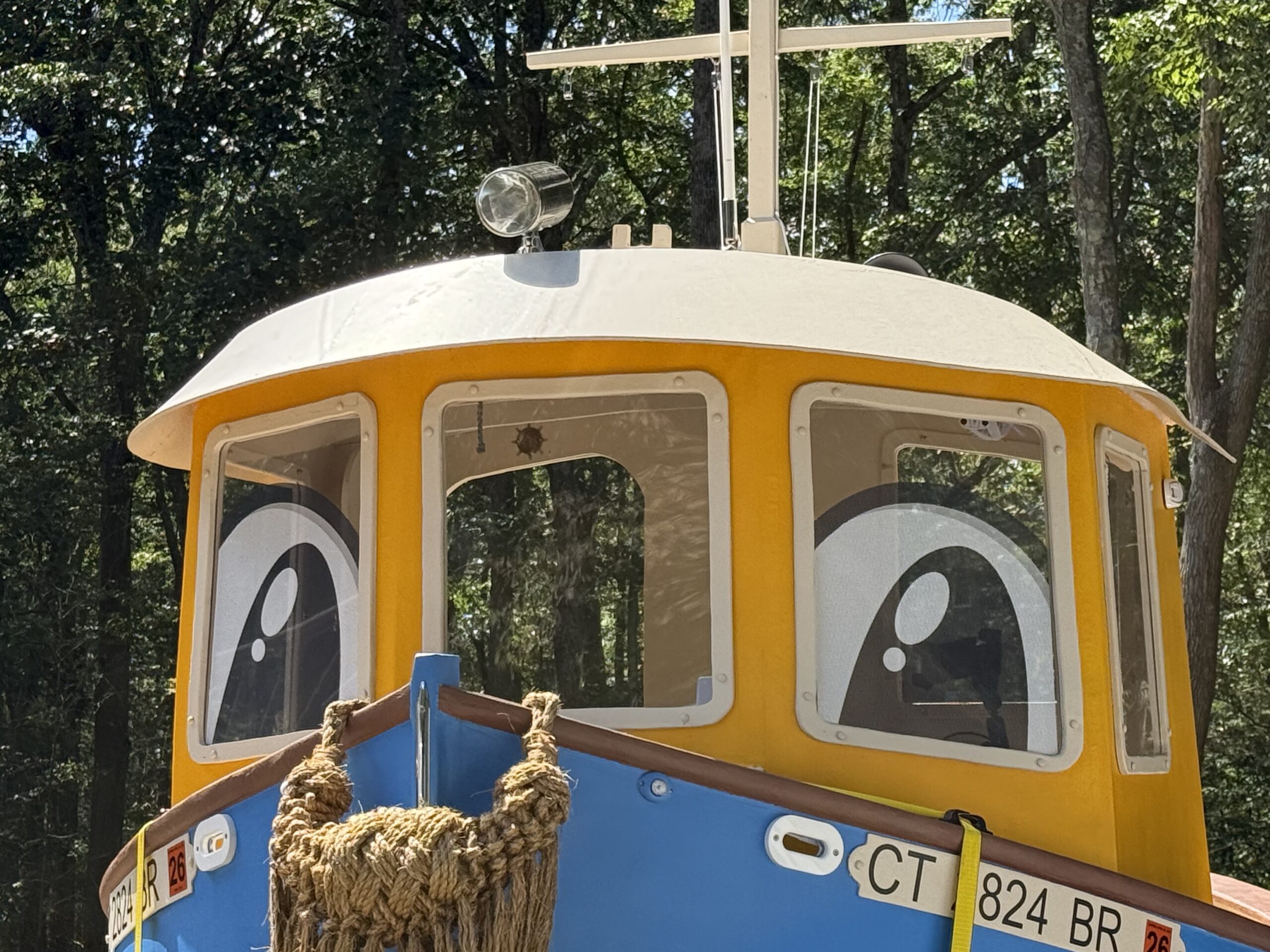
Three years. A two-car garage. Twenty-four sheets of marine plywood, sixteen gallons of epoxy, and a heroic amount of tears. This is the full construction story of a 14′3″ mini tugboat: from bare bottom panels to a boat with her own pair of eyes.
3 yrs
In the build
300+
Build photos
24
Sheets of ply
14′3″
Of attitude
A Berkeley Engineering CANDU E-Z
A real boat, built by one stubborn human
AWOOGA was built from Berkeley Engineering’s CANDU E-Z plans using marine plywood, fiberglass cloth, and epoxy: learning curve, mistakes, do-overs and all. Every photo below is part of the real story, captions and dates exactly as they happened.
Short on time?
The build in 10 photos
Three hundred photos is a lot to scroll. If you only have a minute, here’s the whole three-year story, plywood to launch day, in ten. Tap through at your own pace.
The design behind the boat
What exactly is a CANDU E-Z?
Long before AWOOGA had a name, she had a set of plans. The CANDU E-Z is a pocket-sized wooden tugboat designed by Berkeley Eastman of Berkeley Engineering & Research, his very first design, drawn up back in 1986, and the boat that launched a whole little fleet of mini-tug and houseboat plans. It folds the whole profile of a working harbor tug into fourteen trailerable feet.
- 14′3″Length overall
- 7′0″Beam
- ~17″Draft
- Sleeps 2Carries 3–5
- ~5 mphCruising speed
- 10 HPElectric or outboard
The build
Built from plywood, epoxy & patience
The E-Z is amateur-buildable by design. The hull goes together from marine plywood over a handful of frames: the bottom is laid up from four sheets butted end-to-end, the seams glued with epoxy and reinforced with fiberglass tape, and the ¼″ topsides are skinned in cloth and epoxy. No lofting wizardry, no steam-bent ribs, just careful cutting, gluing and fairing. It’s the exact recipe AWOOGA was built with, do-overs and all.
The power
Quiet power, trailer and all
The original drawings drop a 10 HP electric motor into the engine box (no fumes, no fuel, no vibration, just a clean five-mile-an-hour amble), though plenty of builders fit a small gas outboard instead. She’s fully trailerable, and the plans include the trailer conversion too. Many builders make her their own, stretching the length a foot or raising the cabin for standing headroom.
The plan set
≈ 65 pagesSixty-five pages of “you can do this”
The CANDU E-Z plan set runs about 65 pages: the lines of the boat, photographs of every build stage, a full inventory of materials, a summarized build sequence, and dimensioned drawings for every single component. They’re still sold by the Eastman family through Berkeley Engineering & Research, the same plans that spent twelve years on Adam’s wall before the first sheet of plywood was ever cut.
Thinking of building one? Start with the honest guide → Or learn to read the blueprint at the Drafting Table →
Design & specifications: Berkeley Eastman / Berkeley Engineering & Research (berkeley-engineering.com), with additional build detail from Small Boats Magazine. AWOOGA is one hand-built CANDU E-Z among many.
Straight from the garage
In the builder’s words
The honest version of how AWOOGA came together: pulled straight from Adam’s build notebook. A few pages here; the rest are in the notebook itself.
More than you’d think. I bought 21 gallons, used roughly 16 building her and, if I’m honest, wasted close to 5. Estimating epoxy is harder than it looks.
Cutting the motor hole, hands down, the scariest cut of the whole project. Then the fiberglass cloth I’d bought had a finer weave than I was used to: if I didn’t wet the surface out first, the epoxy just wouldn’t soak in. I learned that the hard way: laid the cloth, watched it refuse to saturate, then ripped it all off, sanded it down, and did it over.
From the keel up
The build, stage by stage
AWOOGA came together in roughly ten chapters. Here’s how a stack of plywood became a tugboat.
Aug – Oct 2022
The Bottom
Marine plywood delivered, bottom panels cut and faired, seams taped with fiberglass, chine logs and bulkhead bases set, and the water side glassed.
Nov 2022 – Apr 2023
Keel & Side Keels
Keel frame built and foam-filled for flotation, dry-fit, then sealed and glassed, “not a fun task,” in the builder’s words.
Nov 2022 – Aug 2023
Hull Assembly
Hull skins laid out and cut, interiors glassed, port and starboard sides bonded on, stern skinned, and the fir rail cap fitted.
May – Sep 2023
Structure & Systems
Stem installed, motor well fabricated, trailer bunks rebuilt, deck stringers and the forward deck added.
Sep 2023 – Aug 2024
Exterior Finishing
Two layers of cloth on the outside hull, fairing, primer and paint, scuppers: “some lipstick on this pig.”
May – Sep 2024
Cabin & Helm
Cabin walls raised, roof beams and visor fitted, the roof closed in, and the helm station built up.
Sep 2024
Motor & Mast
20 HP Tohatsu hung and wired, steering and throttle run, and a clever lever-action folding mast (a TooT TooT tip).
Oct 2024 – Apr 2025
Cockpit & Fit-Out
Aft cockpit seating built over the gas-tank void and a cover made for the motor, then the cabin finished out: window and door frames fitted and vinyl flooring laid.
Apr 27, 2025
Launch Day
Decals and registration on, custom bow pudding from Mystic Knotwork, a launch ceremony, and she floats. Mike, who built TooT TooT, came to watch.
Sep 2025
Full Cartoon
Perforated eye decals, stadium seating with the AWOOGA logo, a bubble-blowing smoke stack, and a feature in WoodenBoat Magazine’s Launchings.
Three years in one slider
Watch her come together
Drag the slider to explore every photo in order, or hit Play highlights for the whole build in about thirty seconds, milestone by milestone.
Every nut, bolt & brushstroke
The full build gallery
Filter by stage, search the captions, then tap any photo to open the lightbox.
Bonus exhibit · recovered from the drafting table
A perfectly good schematic, Awoogified
In 1997, Berkeley Engineering drew the CANDU E-Z with the quiet dignity of a real working boat. Then Adam got hold of the drawing. Drag the pencil across the sheet, or press the button and let the attitude take over. And here’s the part nobody asked about: AWOOGA wasn’t even the first idea. There was a pitch meeting. It did not go well.
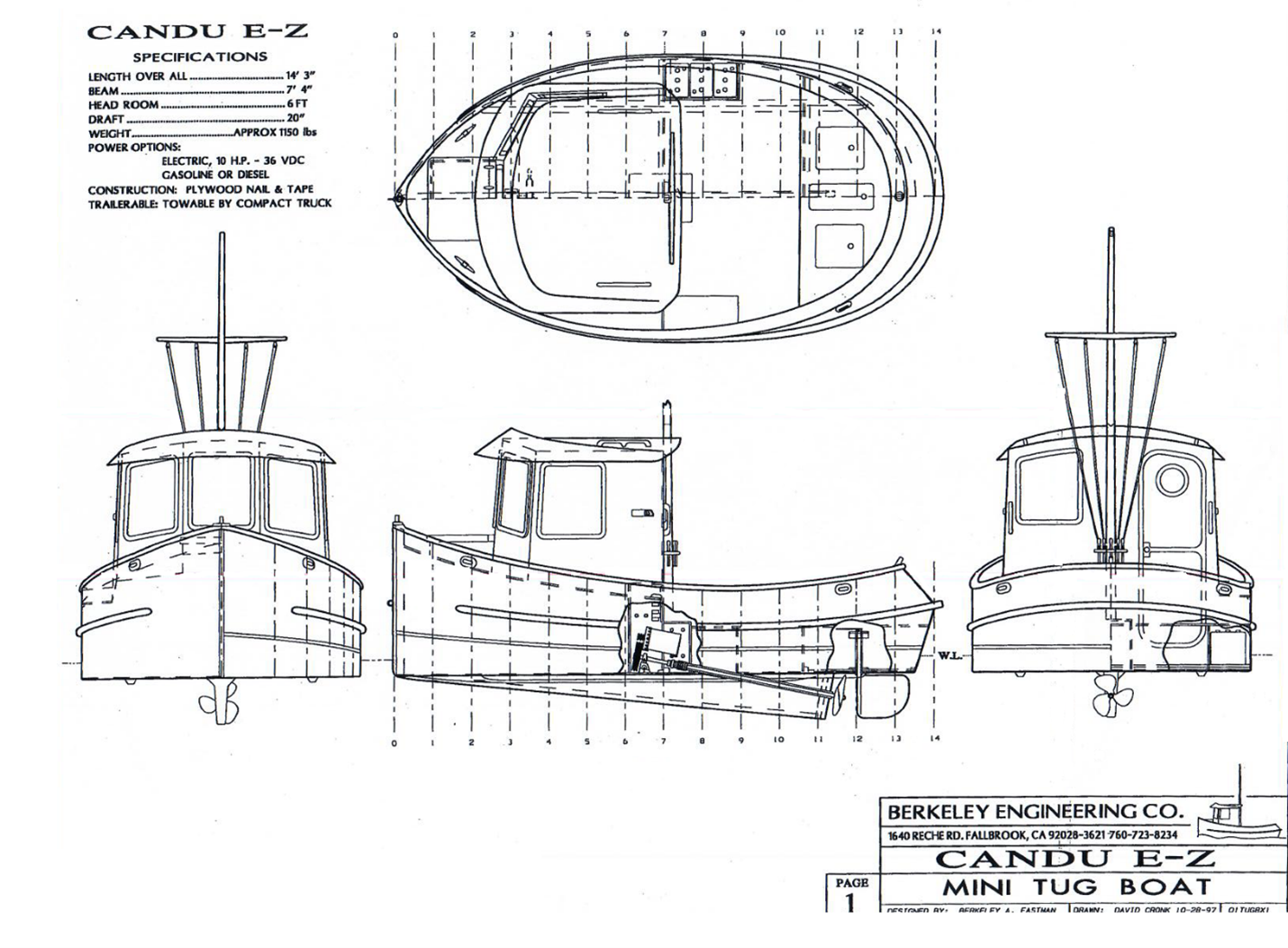
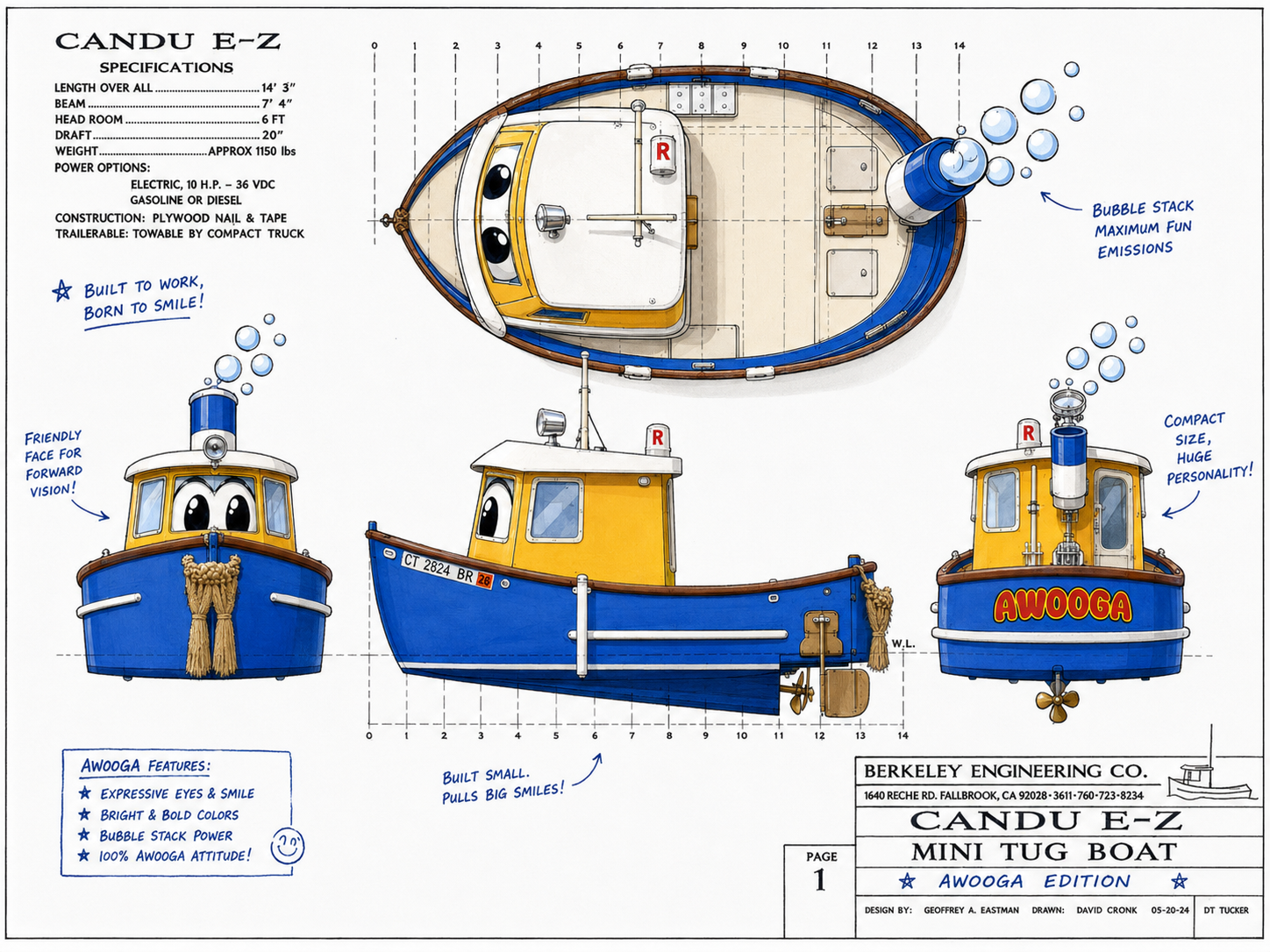
Original drawing: Berkeley Eastman / Berkeley Engineering & Research. The “improvements” are entirely Adam’s fault. The other ten pitches, somehow, also Adam’s fault.
Curious what a boat like this costs?
We tracked every receipt. See the real numbers, run your own estimate, or read the story behind the boat.